When your shop needs to produce cylindrical shells for pressure vessels or wind tower sections with minimal material waste, the choice between plate bending machines becomes critical. 4-roll plate bending machines have transformed how fabricators approach heavy plate forming, eliminating pre-bending operations and reducing scrap rates by up to 15% compared to traditional methods.
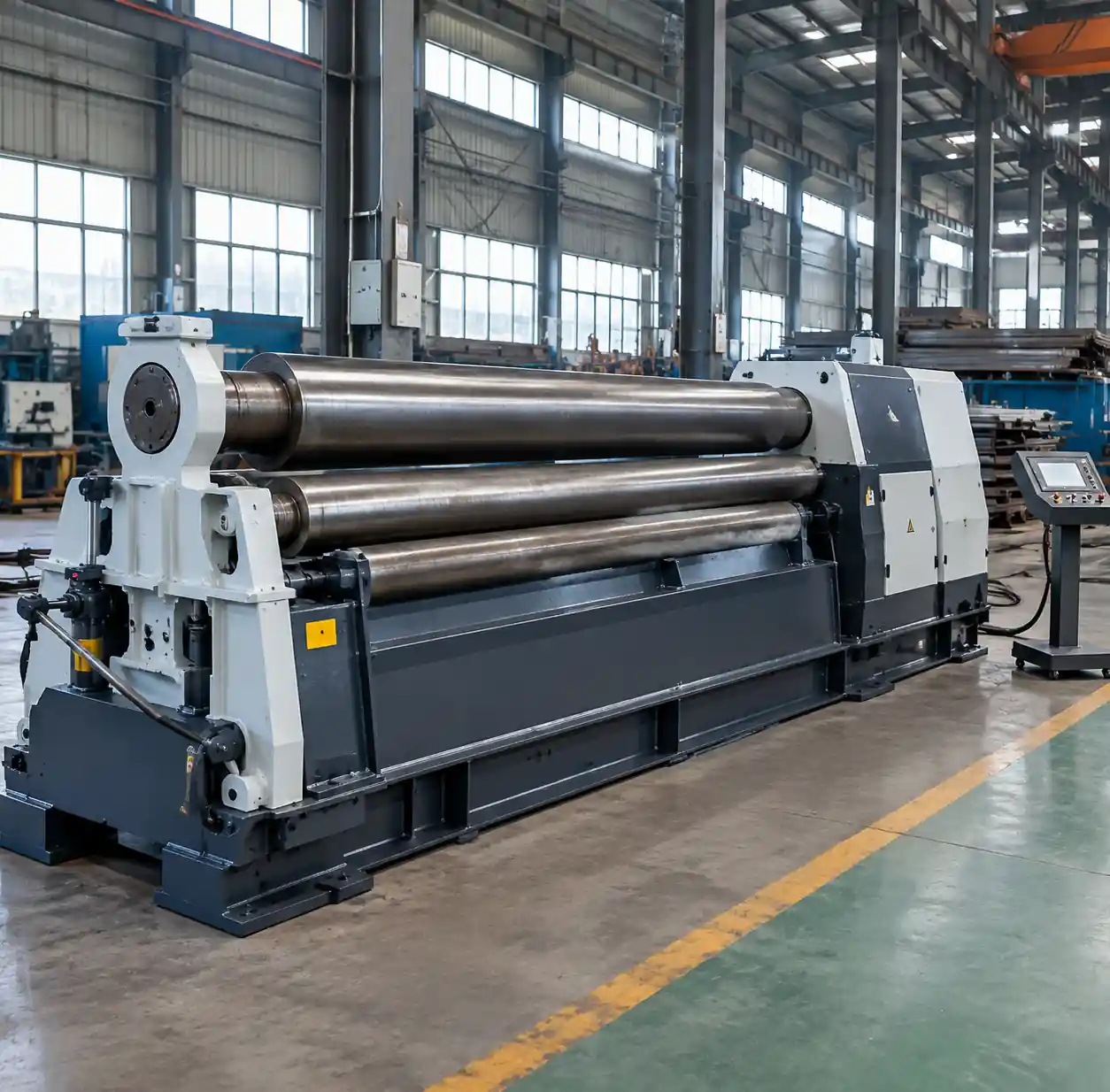 4-roll plate bending machine in industrial metal fabrication workshop
A 4-roll plate bending machine uses four rollers arranged to grip and form the plate in a single setup. The top and bottom rollers clamp the material while two side rollers create the bend radius. This configuration allows the machine to roll the plate's edges without repositioning, solving the biggest limitation of 3-roll designs.
The key advantage is continuous forming capability. Unlike 3-roll machines that leave 150-300mm of flat edge requiring secondary pre-bending, 4-roll systems bend material edge-to-edge. For a 12-meter wind tower section, this eliminates roughly 3.6 meters of additional welding and material preparation per cylinder.
| Feature | 3-Roll Machines | 4-Roll Machines |
|---|---|---|
| Edge Pre-Bending | Requires separate operation or manual press | Automatic edge bending in same setup |
| Material Waste | 5-8% flat edge remnant | <2% with proper setup |
| Operator Skill Level | High - requires experience for quality | Moderate - more forgiving process |
| Cycle Time (per piece) | Longer due to pre-bending | 20-30% faster for complete cylinders |
| Initial Investment | Lower ($80K-$200K) | Higher ($150K-$500K+) |
| Maintenance Complexity | 3 roller systems, simpler | 4 roller systems + additional hydraulics |
The productivity difference becomes dramatic in high-volume operations. A fabricator running wind tower sections can eliminate an entire workstation by moving from 3-roll to 4-roll, recovering the equipment premium within 18-24 months on production runs exceeding 200 shells annually.
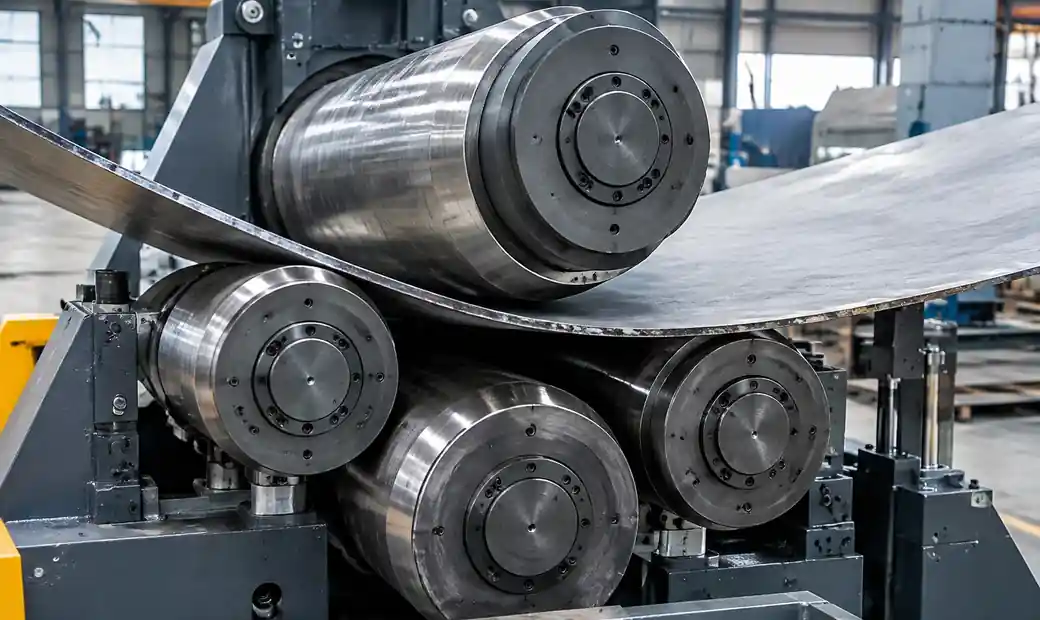 Close-up view of 4-roller configuration showing top bottom and side rollers
Modern 4-roll machines come in two control categories, and the performance gap is significant.
Standard Hydraulic Systems use proportional valves to position rollers. These deliver:
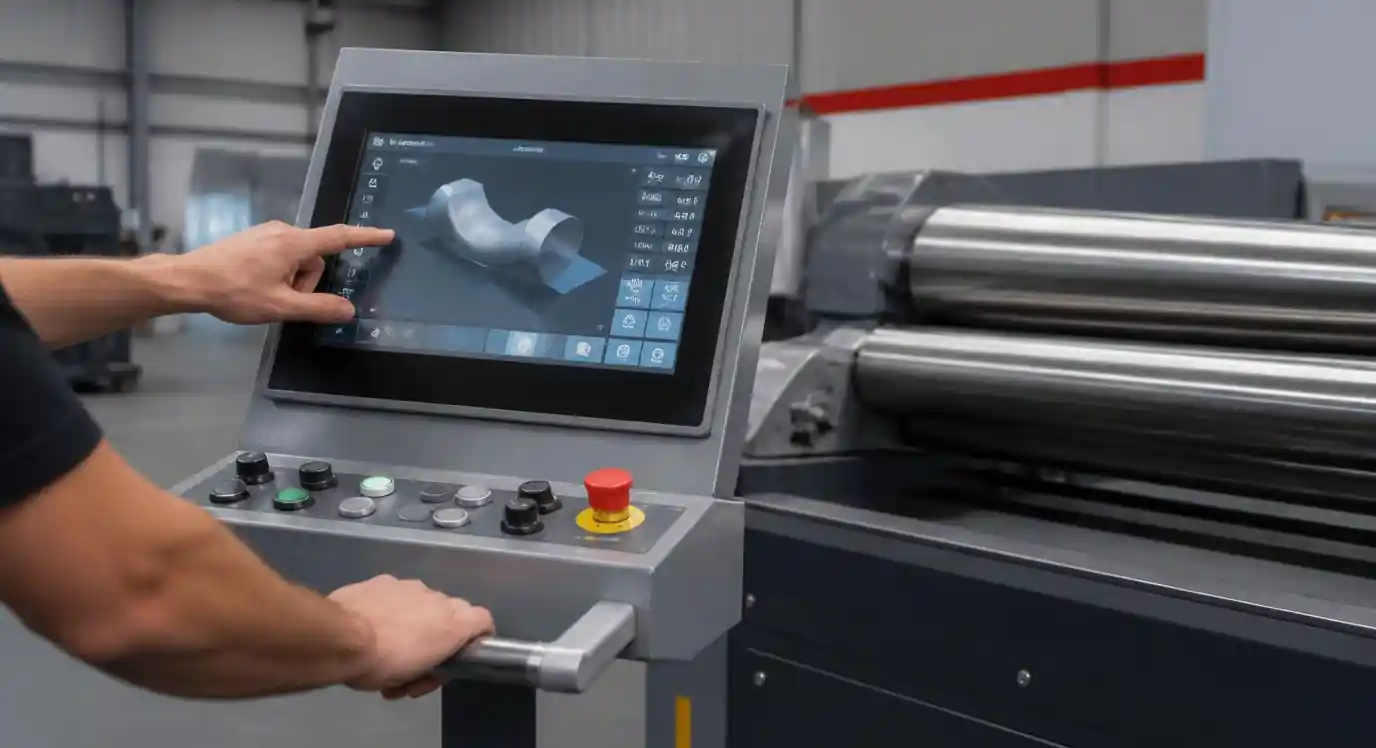 CNC servo control panel on modern plate bending machine with operator interface
CNC Servo Systems replace hydraulic positioning with servo-electric drives:
CNC servo control panel on modern plate bending machine with operator interface
CNC Servo Systems replace hydraulic positioning with servo-electric drives:
The EZHONG CNC servo 4-roll system demonstrates this precisely. On a recent pressure vessel project requiring 50 shells at 2400mm diameter with ±2mm tolerance, the servo system held ±0.8mm across all pieces. The equivalent hydraulic machine required manual adjustment every 8-10 shells to maintain the same tolerance window.
Energy savings compound over time. A 100-ton capacity servo machine running two shifts saves approximately $12,000-$18,000 annually in electricity costs compared to full hydraulic systems, based on industrial rates of $0.12/kWh.
Capacity ratings follow a thickness × width format (e.g., 40mm × 3000mm), but real-world capability depends on material yield strength.
Calculating Actual Capacity:
The formula fabricators use: Adjusted Capacity = (Rated Thickness) × (235 MPa / Material Yield Strength)
Example: A machine rated for 40mm × 3000mm rolling mild steel (235 MPa) handles these materials:
| Machine Rating | Mild Steel | Q345 | Q420 | Application Sweet Spot |
|---|---|---|---|---|
| 25mm × 2500mm | 25mm | 17mm | 14mm | Tanks, HVAC ducting |
| 40mm × 3000mm | 40mm | 27mm | 22mm | Pressure vessels, boilers |
| 60mm × 3000mm | 60mm | 41mm | 34mm | Heavy pressure vessels |
| 90mm × 4000mm | 90mm | 61mm | 51mm | Wind tower base sections |
For pressure vessel applications working with P11 or P22 chrome-moly alloys, factor the elevated yield strength. A 36mm chrome-moly shell requires a machine rated for at least 50mm mild steel capacity.
Pressure Vessel Manufacturing
ASME Section VIII fabrication demands tight diameter tolerances—typically ±0.5% for vessels under 3 meters diameter. On a 2000mm diameter vessel, that's ±10mm total tolerance.
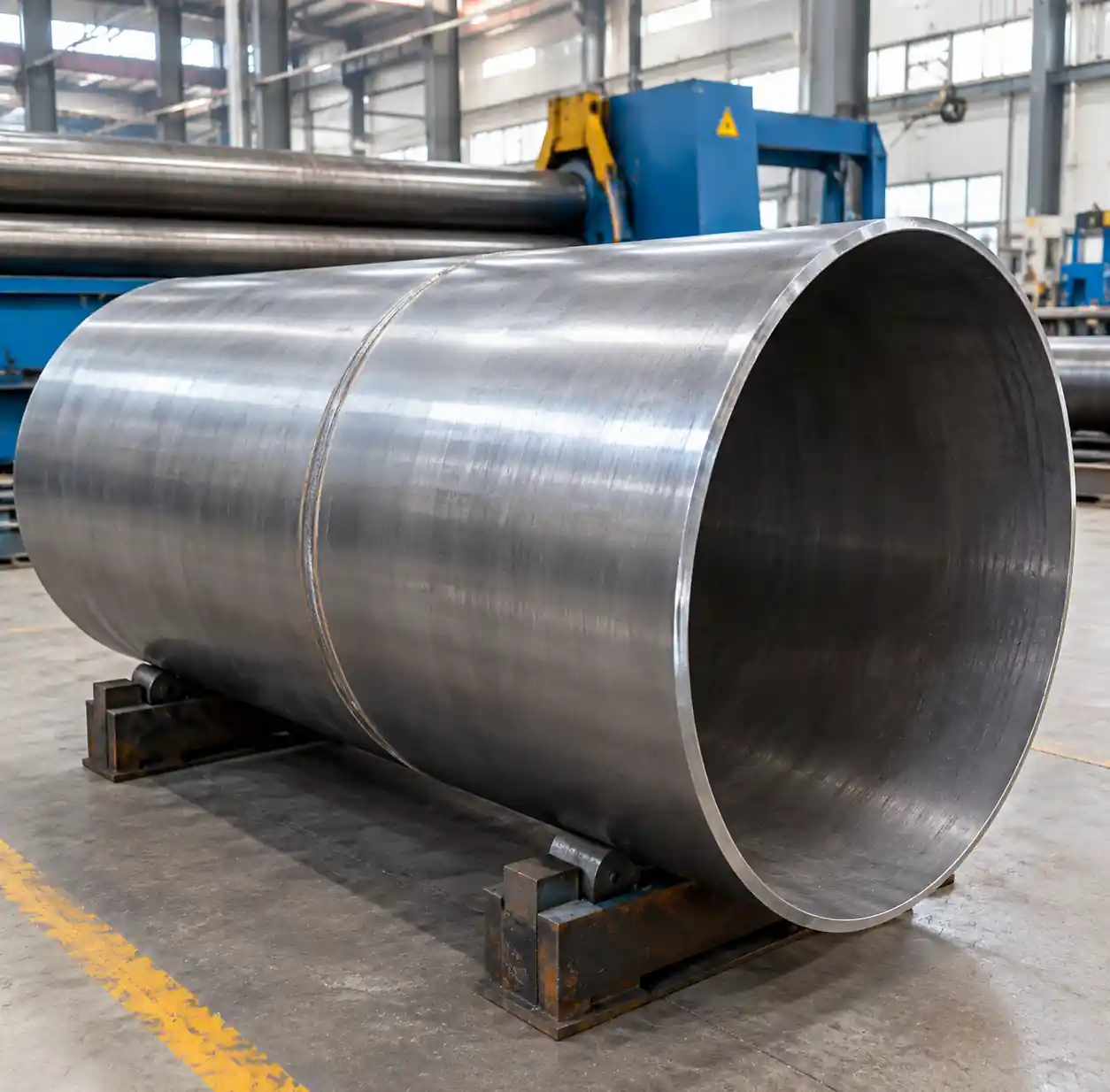 Completed pressure vessel cylinder shell formed by 4-roll plate bending machine
4-roll machines meet this through consistent clamping pressure. The four-roller grip prevents plate slippage that causes diameter variation in 3-roll systems. Our experience with standard 4-roll machines shows they maintain ±3-4mm diameter consistency across production runs when properly calibrated.
Material thickness for pressure vessels ranges 12mm to 120mm depending on design pressure and diameter. Thicker shells require pre-heating—above 40mm thickness, most shops heat material to 150-200°C before rolling to reduce springback and prevent microcracking in the bend zone.
Wind Tower Production
Wind tower shells represent the most demanding plate rolling application. Base sections reach 90-100mm thickness, 4500mm diameter, and require ±0.3% diameter tolerance for proper segment fit-up during field assembly.
The production economics are tight. A tower fabricator producing 150 towers annually processes roughly 450-500 shell sections. At 85% equipment utilization, that's 1-2 shells per shift. Any quality issue that prevents automated welding downstream costs 4-6 hours of rework labor plus welding consumables.
4-roll CNC systems reduce this risk significantly. Stored programs ensure dimensional consistency, and the continuous edge forming prevents the waviness that occurs when pre-bent edges don't match the cylinder radius perfectly.
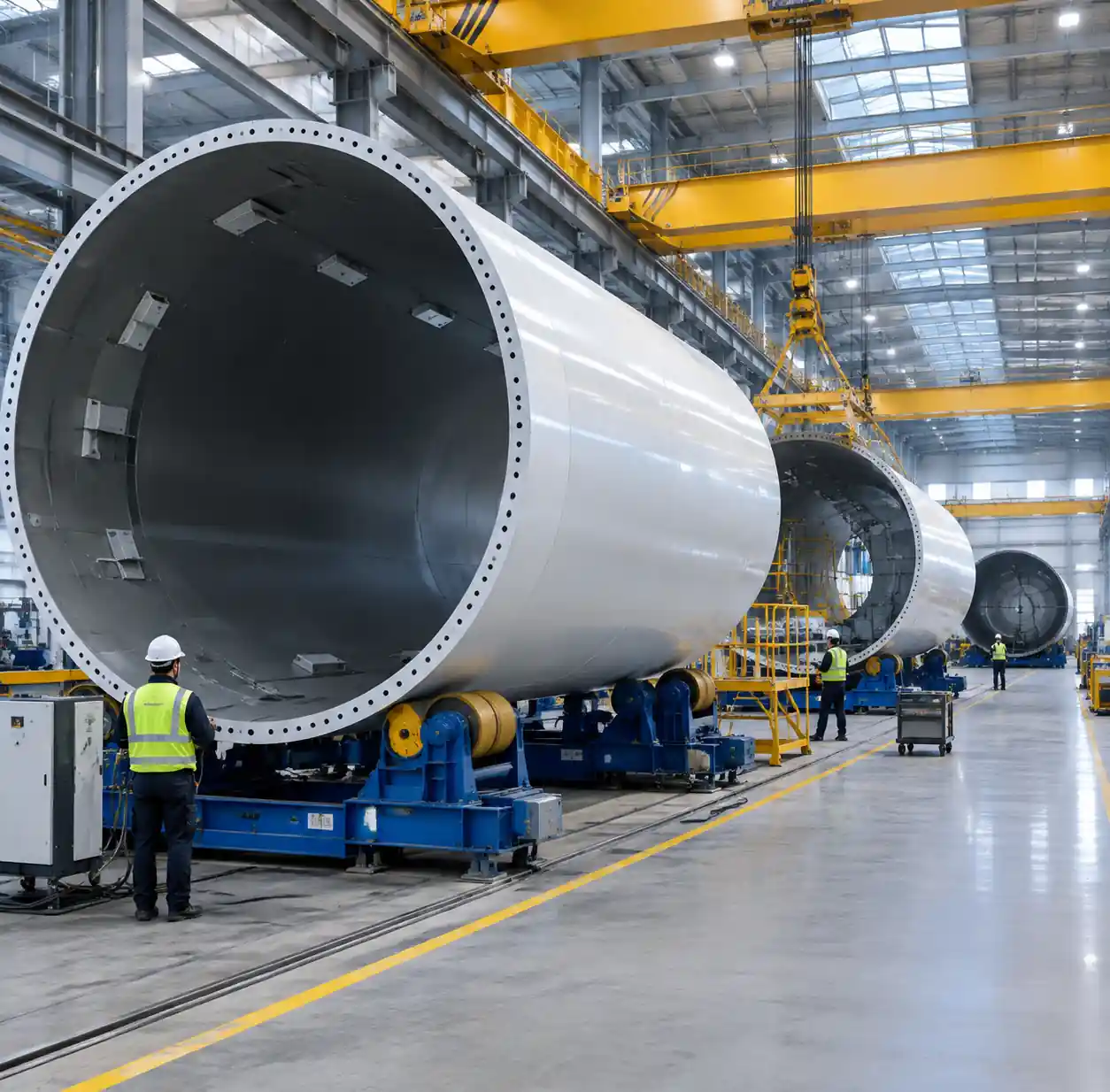 Wind tower section being produced in industrial fabrication facility
Investment justification depends on production volume and product mix.
Wind tower section being produced in industrial fabrication facility
Investment justification depends on production volume and product mix.
Scenario 1: Medium Volume Job Shop
Annual waste cost: $6,400 Labor savings (pre-bending): 2.5 hours/piece × 120 pieces × $35 = $10,500 Total annual benefit: $16,900
4-roll hydraulic upgrade cost: $180,000 Simple payback: 10.7 years - not justified
Scenario 2: High Volume Production
Annual waste cost: $16,000
Labor savings: $26,250
Quality improvement savings: $19,800
Total annual benefit: $62,050
4-roll CNC servo investment: $280,000 Simple payback: 4.5 years - justified
The threshold typically falls around 180-200 cylinders annually for standard 4-roll systems, dropping to 120-140 pieces for CNC servo systems when quality requirements are tight.
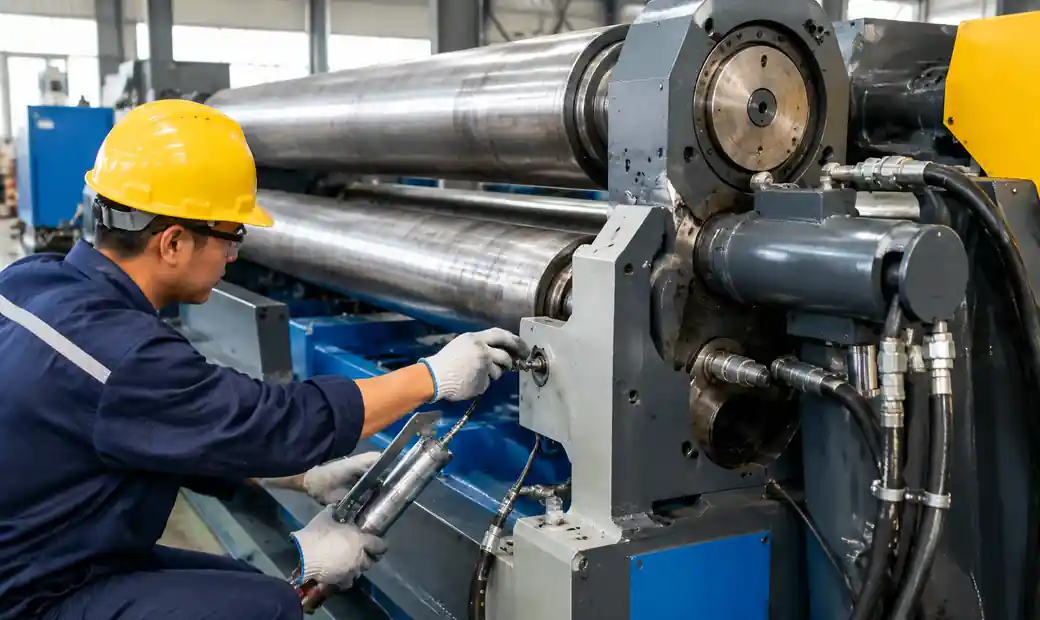 Maintenance work on 4-roll plate bending machine showing roller assembly
4-roll machines require systematic maintenance, but the schedule is manageable.
Daily (10 minutes):
Weekly (45 minutes):
Monthly (2-3 hours):
Annual (8-12 hours + downtime):
Roller replacement represents the largest maintenance cost. Heavy-use operations (>1500 hours/year) typically resurface or replace rollers every 3-5 years at $15,000-$30,000 depending on machine size. CNC servo systems add control system maintenance, but the lack of proportional hydraulic valves actually reduces hydraulic component wear.
Budget approximately 2-3% of machine purchase price annually for routine maintenance parts and consumables.
Before committing to a 4-roll plate bending machine investment, answer these questions:
What is your maximum material thickness and width? Add 20% margin to your largest anticipated part.
What materials will you process? High-strength alloys require 40-60% more capacity than mild steel.
What diameter range do you need? Minimum diameter capability matters—small diameters require greater roller pressure.
What are your tolerance requirements? ±5mm = standard hydraulic; ±2mm = CNC servo recommended.
What is your annual production volume? Under 150 cylinders may favor 3-roll; over 200 strongly favors 4-roll.
Do you have pre-heating capability? Required for materials over 40mm thickness.
What is your available floor space? 4-roll machines need 30-40% more floor space than equivalent 3-roll.
What is your operator skill level? 4-roll systems are more forgiving but still require trained operators.
Compare 3-roll alternatives if your production volume is lower or part mix includes many small-diameter, thin-wall cylinders where 3-roll excels.
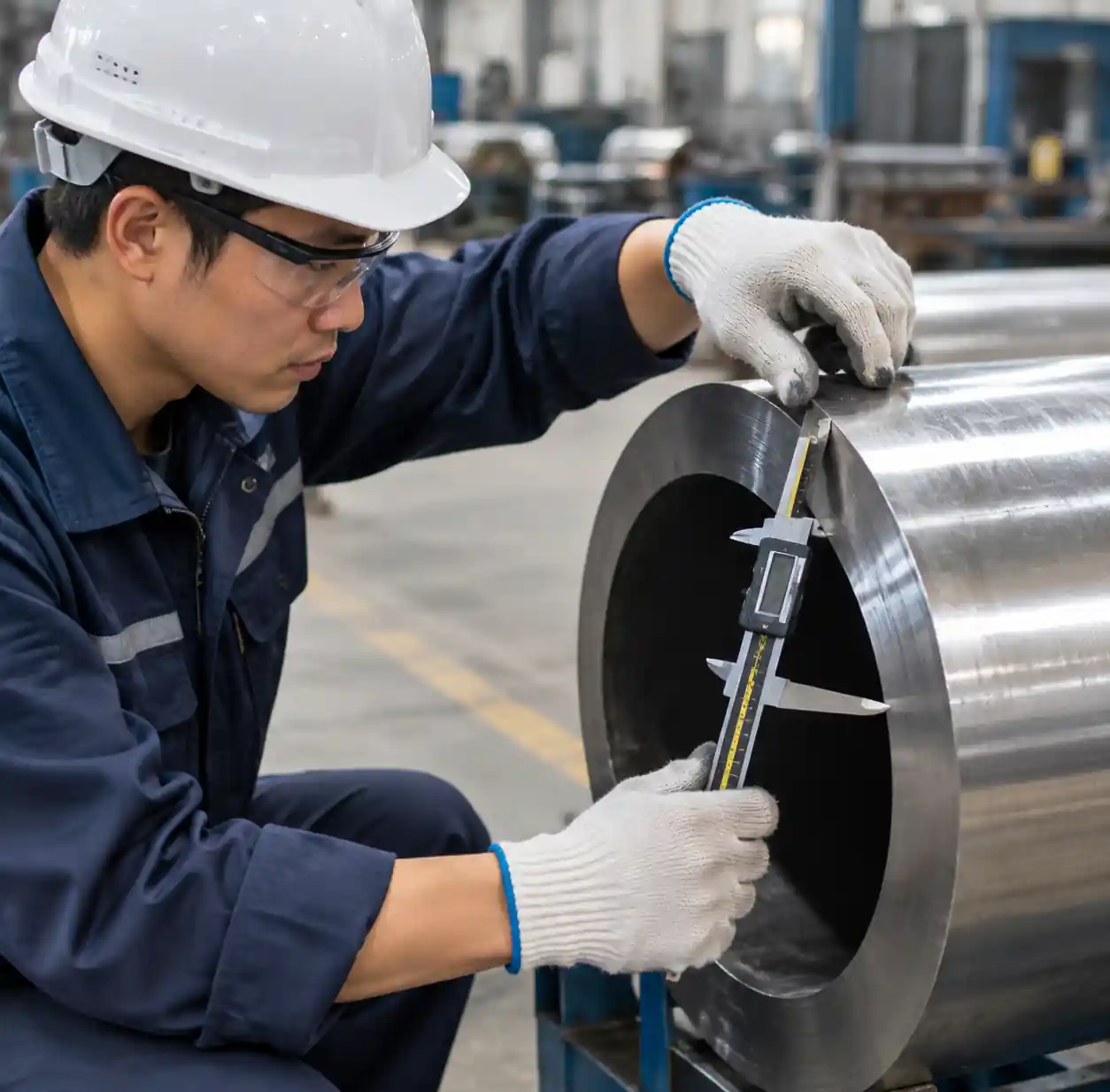 Operator measuring diameter of formed cylinder for quality control
How long does it take to learn to operate a 4-roll plate bending machine?
A skilled metal worker with general fabrication experience typically requires 40-60 hours of supervised operation to achieve consistent results on straightforward cylinders. Complex shapes or tight tolerances require 3-6 months of regular operation to develop the judgment for parameter adjustment. CNC servo systems with stored programs reduce this learning curve by approximately 30-40%.
Can 4-roll machines handle conical shapes?
Yes, but with limitations. Standard 4-roll machines can produce shallow cones (included angles greater than 160°) by adjusting one side roller differently than the other. Steeper cones require specialized conical bending attachments or dedicated cone rolling machines. Most wind tower and pressure vessel cones fall within the capability range of properly equipped 4-roll systems.
What causes diameter variation in finished cylinders?
The three most common causes are inconsistent material thickness (check mill certs), roller surface contamination or damage (daily inspection), and incorrect roller pressure distribution (requires recalibration). Material with more than 0.3mm thickness variation across width will produce diameter variation regardless of machine quality. Temperature variation during rolling of pre-heated thick plate also contributes significantly.
How do hydraulic systems compare to mechanical systems?
Modern industrial 4-roll machines use hydraulic systems almost exclusively for roller positioning because they provide smooth, controllable force across the full thickness range. Mechanical systems with screw-drive positioning exist primarily on smaller machines (under 25mm capacity) where their simpler maintenance offsets the reduced control precision. For production environments, hydraulic positioning with CNC or servo control is the proven choice.
What electrical requirements should I plan for?
Standard hydraulic 4-roll machines typically require 380-480V three-phase power. Main motor ratings range from 30kW (40 HP) for smaller machines up to 150kW (200 HP) for large, heavy-capacity systems. CNC servo models may require an additional 15-25kW for servo drives and control systems. Ensure your facility has adequate amperage—a 100kW system draws approximately 150-180 amps at 480V. Most installations require dedicated transformer capacity.
4-roll plate bending machines deliver measurable advantages for fabricators producing cylindrical shells in volume. The elimination of pre-bending operations, reduction in material waste, and improvement in dimensional consistency create tangible ROI when production exceeds 180-200 cylinders annually.
The choice between standard hydraulic and CNC servo systems depends on tolerance requirements and production volume. For pressure vessel work requiring ±0.5% diameter tolerance or wind tower production with stringent fit-up requirements, CNC servo systems justify their premium through reduced rework and faster setup. Job shops with mixed production and more forgiving tolerances will find standard hydraulic 4-roll systems provide the core benefits at lower initial investment.
Capacity selection requires careful attention to material yield strength—always calculate adjusted capacity for your actual materials rather than relying on mild steel ratings. Maintenance demands are higher than 3-roll systems but manageable with proper scheduling and operator training.
For fabricators at the decision point, audit your current production: cylinder count per year, scrap costs, pre-bending labor hours, and quality-related rework. These numbers reveal whether 4-roll technology will deliver returns in your specific operation. The machines are a significant investment, but for the right production environment, they eliminate bottlenecks and quality issues that have constrained plate fabrication operations for decades.
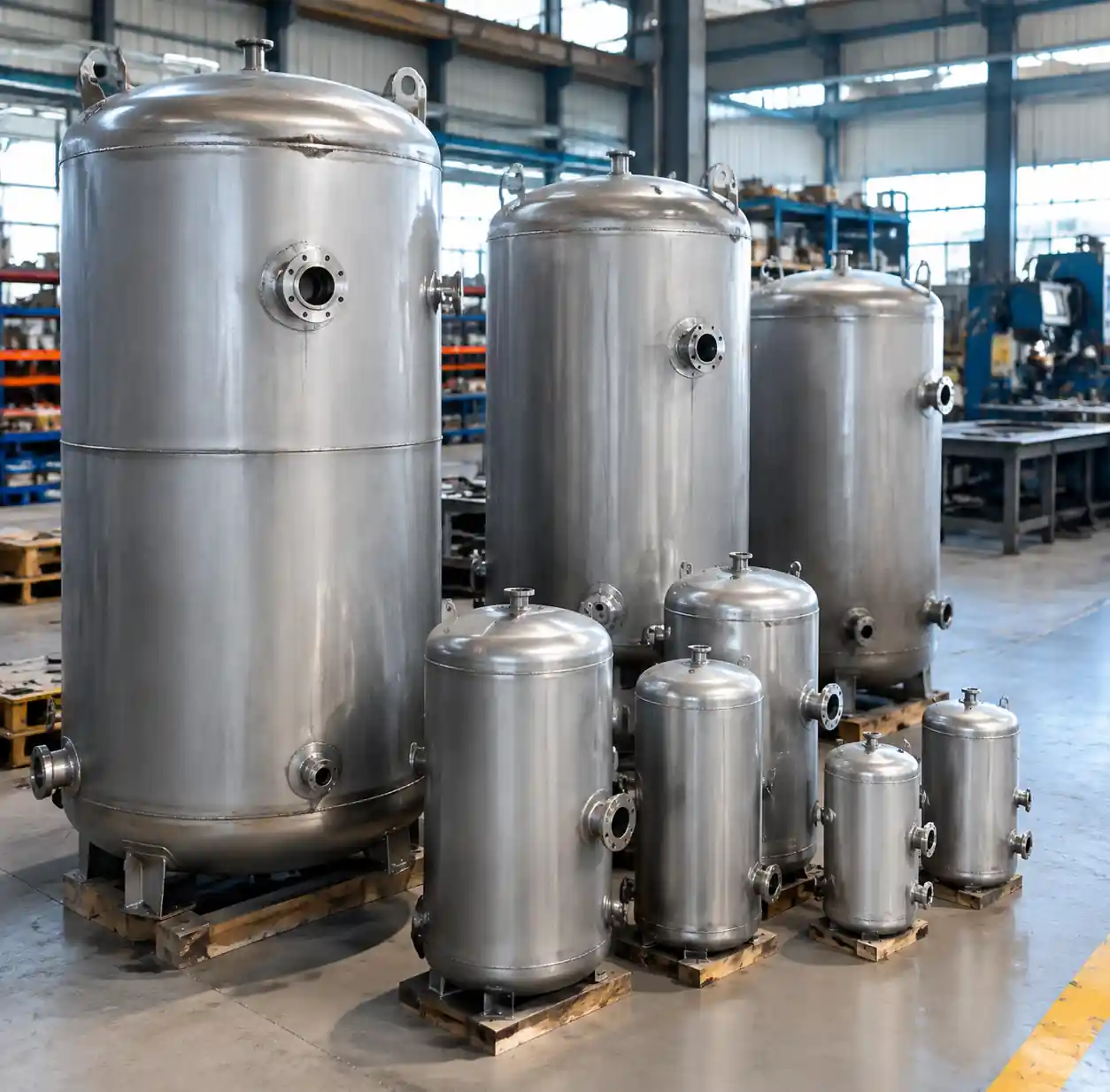 Multiple formed metal cylinders on workshop floor showing production capacity