Manufacturing ASME-certified pressure vessels demands equipment that delivers precision at scales most shops never encounter. After spending 15 years commissioning rolling mills for boiler manufacturers and refineries, I've learned that getting vessel shells within ±1.5mm tolerance on 80mm SA-387 Grade 22 plate isn't about better operators—it's about machines purpose-built for the extremes.
This guide covers forming equipment, tooling, and quality systems that separate compliant pressure vessel production from expensive rework cycles.
Pressure vessels operate under internal pressures from 15 to 3,000+ psi, often at elevated temperatures. Forming errors compound through fabrication: a 2mm out-of-round condition on a 3-meter diameter shell translates to fit-up gaps requiring grinding, re-rolling, or rejection.
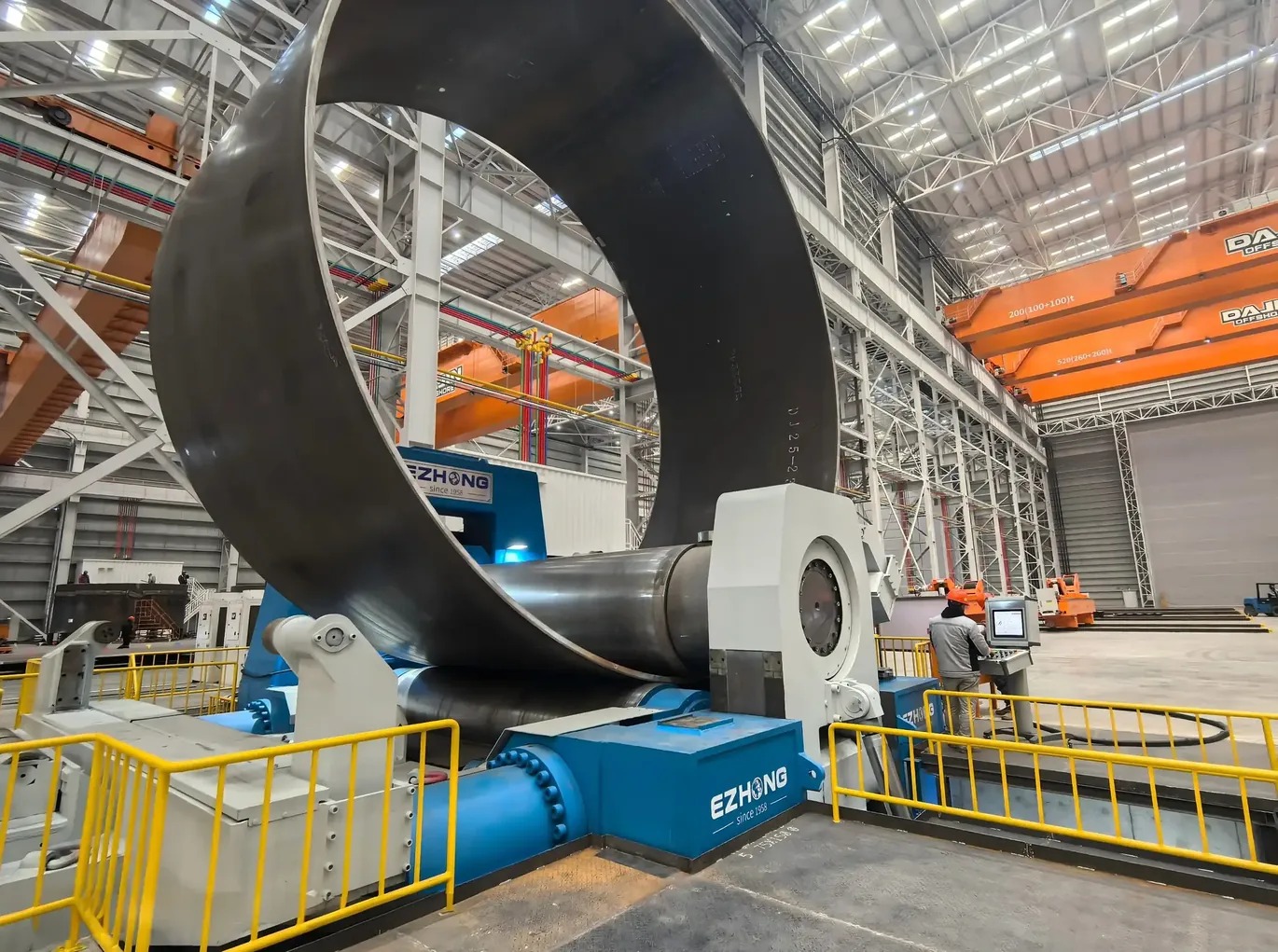 Pressure vessel shell forming on industrial plate rolling machine
Three factors make vessel work distinct:
Material grades: SA-516-70, SA-387 Grade 22, SA-537 Class 1—these chrome-moly and high-strength alloys exhibit different springback characteristics than mild steel. Our trials show SA-387 Gr 22 at 50mm thickness requires 12-18% overbend compensation versus 8-10% for A36 plate.
Thickness range: Vessel shells typically span 25-150mm depending on design pressure. Equipment rated for 40mm mild steel maxes out around 28mm on quenched-and-tempered alloys due to yield strength differences.
Tolerance specifications: ASME Section VIII Division 1 mandates out-of-roundness not exceeding 1% of inside diameter. On a 2.5-meter ID vessel, that's ±25mm total—but practical fit-up for automated welding needs ±5mm or tighter.
| Feature | Three-Roll Pyramid | Four-Roll Machine |
|---|---|---|
| Pre-bending | Requires separate press or edge roller | Eliminates flat edges in single setup |
| Setup time per shell | 25-40 minutes including pre-bend | 12-18 minutes |
| Minimum diameter ratio | 1.5× top roll diameter | 1.3× top roll diameter |
| Thick alloy suitability | Limited by side roll pressure | Superior—all four rolls powered |
| Typical cost (40×3000mm) | $280K-$420K | $480K-$680K |
For shops producing 20+ vessels monthly, four-roll CNC servo machines recoup their premium through eliminated pre-bend operations. EZHONG tests on SA-516-70 plate showed four-roll setups reduced edge scrap from 180mm to 45mm per end—on a 6-meter plate, that's $120-$160 in material savings per shell.
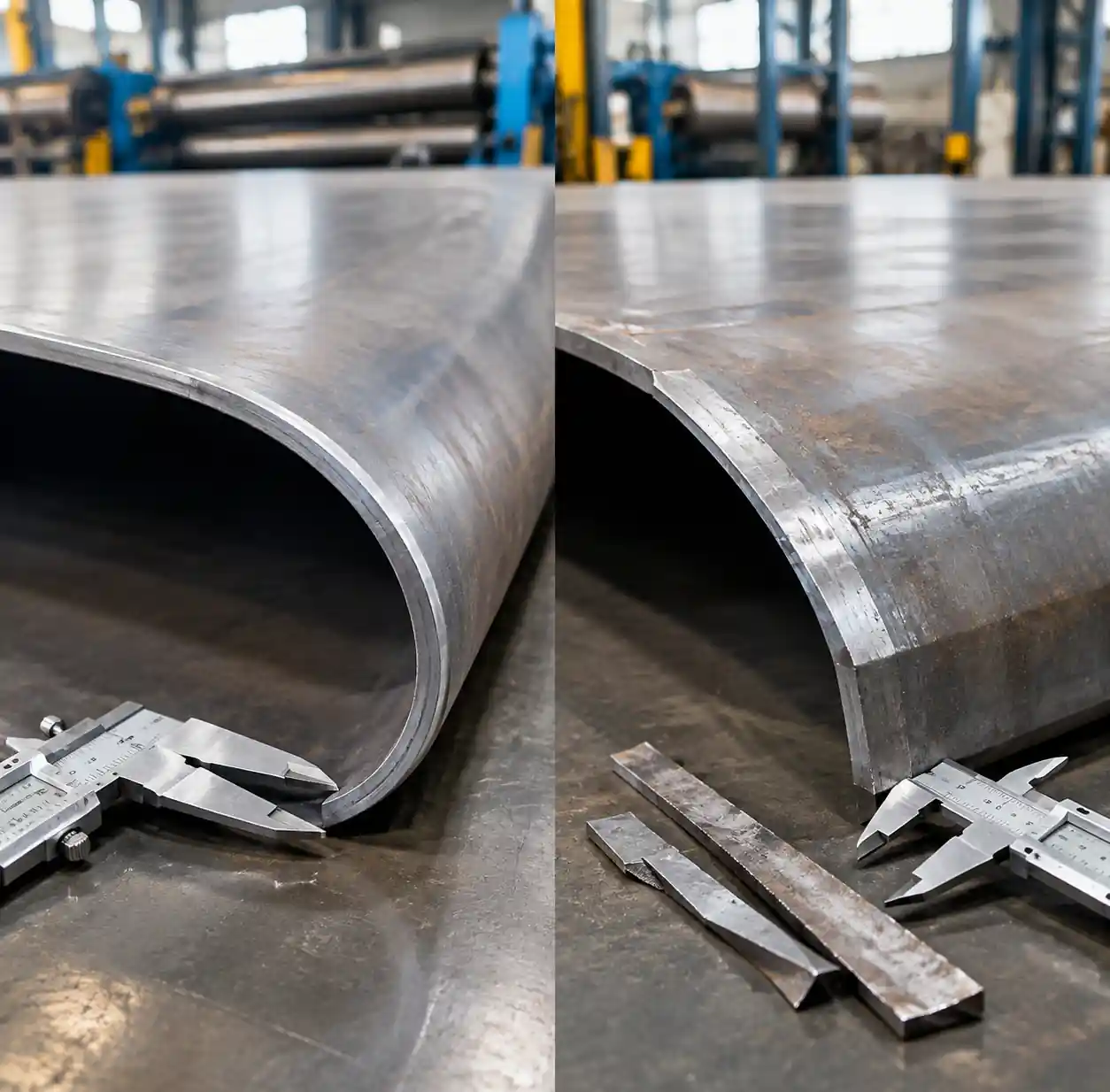 Four-roll plate bending machine eliminating edge pre-bending step
Pressure vessel plate rolling demands sustained tonnage. We specify minimum 350-bar working pressure with proportional valve control.
Cylinder sizing: Each bending roll requires 1.5× theoretical force calculation. A machine rated 40mm × 3000mm needs approximately 180 tons main cylinder capacity.
Flow rates: Rolling 60mm plate at production speeds (1.2-1.8 m/min) requires 120-160 L/min pump capacity. Undersized pumps force slower feed rates that increase cycle time and create chatter marks.
Temperature management: Continuous operation on thick alloys generates hydraulic temperatures exceeding 65°C. We mandate air-cooled heat exchangers sized for 80°C ambient—standard in Middle East installations but often overlooked until summer production crashes.
Chrome-moly alloys (SA-387 Gr 11, Gr 22, Gr 91) and high-strength steels (SA-537) behave differently than carbon steel during cold forming.
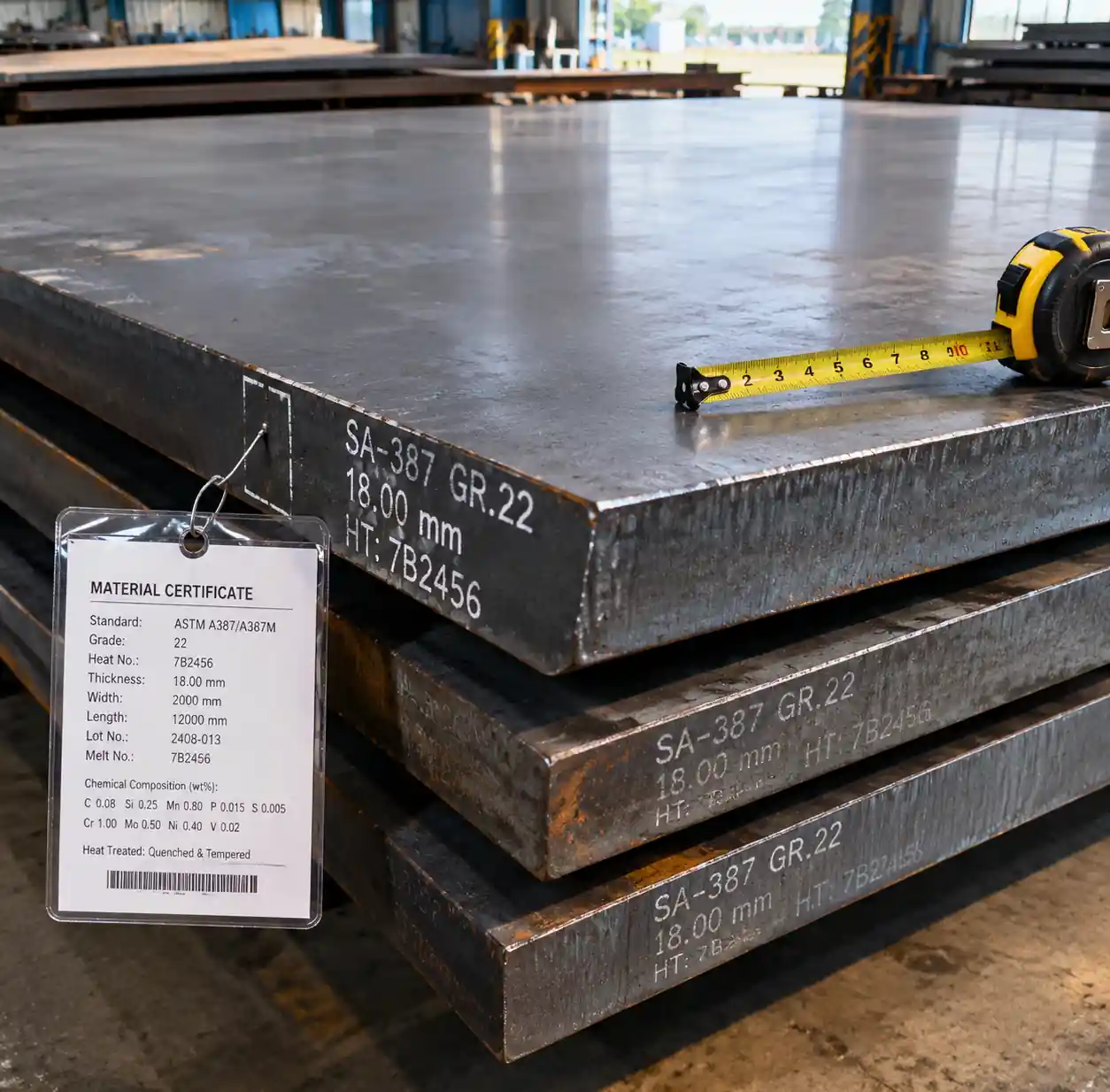 SA-387 Grade 22 chrome-moly alloy plate for pressure vessel manufacturing
Springback: SA-387 Grade 22 exhibits 40-60% more springback than SA-516 at equivalent thickness. Our forming procedures for Gr 22 shell courses include initial diameter underbend of 3.5-4% below target, stress relief at 650°C for 2 hours, then final sizing pass. Skipping intermediate stress relief locks residual stresses that show up as distortion during PWHT.
Work hardening: Multiple passes cold-work the material surface. On SA-537 Class 1 plate we've measured 18-22% hardness increase after four rolling passes—significant enough to alter UT calibration curves.
Pre-heating requirements: We pre-heat SA-516-70 above 65mm to 150-200°C before rolling when ambient drops below 10°C. This prevents micro-cracking and reduces springback variation. Infrared heating blankets positioned at machine infeed maintain temperature during multi-pass forming.
Roll surface loading: Hertzian contact stress at the roll-plate interface reaches 2,200-2,800 MPa on 100mm plate. We specify minimum 450mm diameter work rolls for 100mm applications to prevent roll deflection and premature bearing failure.
ASME Section VIII doesn't prescribe forming methods, but Mandatory Appendix 6 requires documentation for any process affecting material properties.
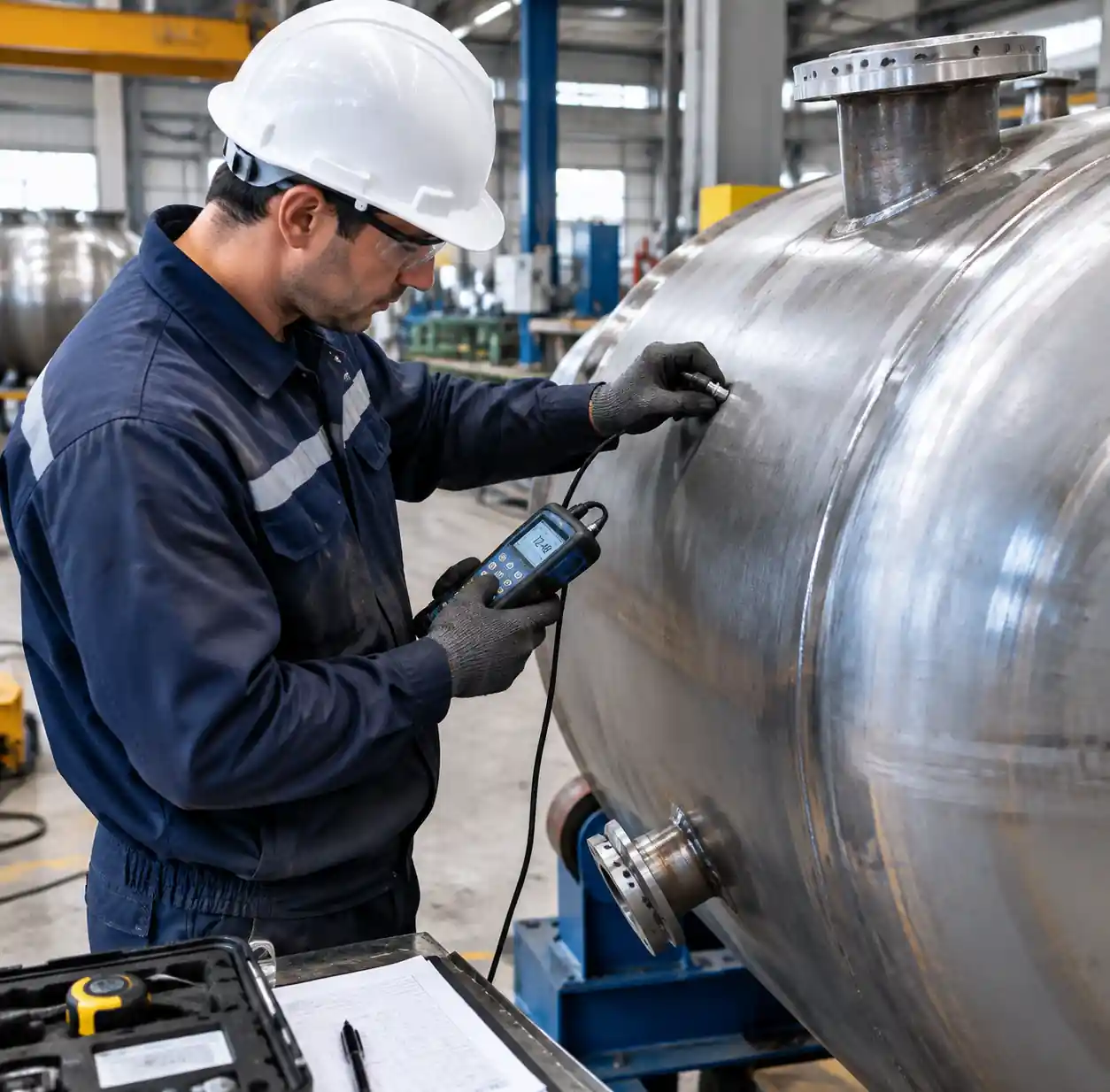 Quality control dimensional inspection of pressure vessel shell to ASME standards
Degree of cold forming: The Code defines "cold forming" as permanent strain exceeding 5% at any point through thickness. Outer fiber strain on 50mm plate rolled to 1500mm ID ≈ 3.2%, but the same plate rolled to 900mm ID ≈ 5.8%. That 900mm shell crosses the 5% threshold, requiring impact testing per UG-84 unless PWHT returns the material to annealed condition.
| Measurement Stage | Parameter | Acceptance Criteria | Measuring Method |
|---|---|---|---|
| Post-rolling | Out-of-roundness | ≤1.0% of ID (Code maximum) | Internal diameter tape, 4 points 90° apart |
| Post-fit-up | Longitudinal seam offset | ≤3mm or t/4 (lesser value) | Height gauge on weld backing bar |
| Post-PWHT | Final out-of-roundness | ≤0.5% of ID (fit-up target) | Ultrasonic diameter measurement |
| Final inspection | Wall thickness | +3.0mm/-0.5mm of nominal | UT thickness mapping, 300mm grid |
The tightest tolerance comes post-PWHT. Stress relief changes vessel geometry—SA-516 shells typically grow 2-4mm in diameter during PWHT. Specialized pressure vessel rolling equipment from EZHONG includes PWHT compensation tables derived from heat treat trials on actual vessel geometries.
Surface damage: Roll surface contamination embeds into plate under forming pressure. We PT-inspect rolled surfaces before fit-up, with rejection at indications >3mm length or >0.5mm depth. Daily roll cleaning and chrome-plated work rolls reduce surface defects 70-80%.
Lamination opening: Pre-existing laminations in plate stock propagate during bending stress. UT examination perpendicular to rolling direction catches these before welding. ASME requires UT per SA-578 Level B for impact-tested materials.
Hydrogen micro-cracking: High-strength alloys (yield >550 MPa) can develop micro-cracks if formed in humid conditions (>80% RH) without pre-heat. We've found this on SA-537 plate formed below 15°C ambient.
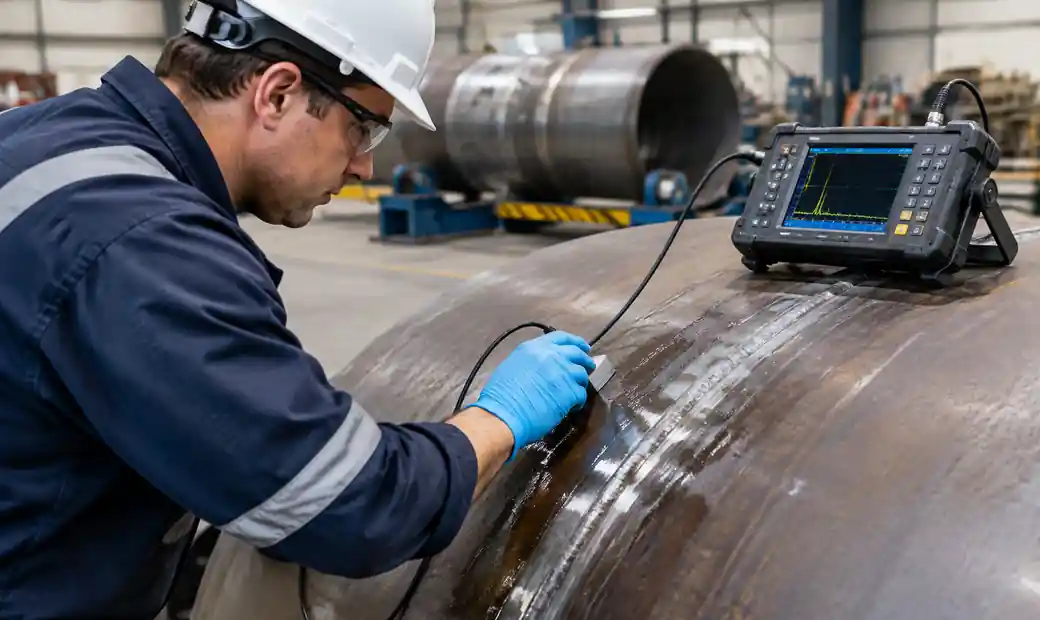 NDT ultrasonic testing on formed pressure vessel shell
Modern CNC servo plate rolling systems log process data that ASME AI inspectors increasingly request: roll position encoder data, hydraulic pressure curves, and plate temperature at infeed. EZHONG machines store 24 months of production data with vessel heat-number linkage. During a recent AI visit at a boiler plant, this data reconstructed forming history for a shell with suspect UT indications, demonstrating no overstress event occurred.
Standard cylindrical rolls create acceptable shells for 2:1 to 4:1 diameter-to-length ratios. Longer shells need crowned rolls to counteract deflection.
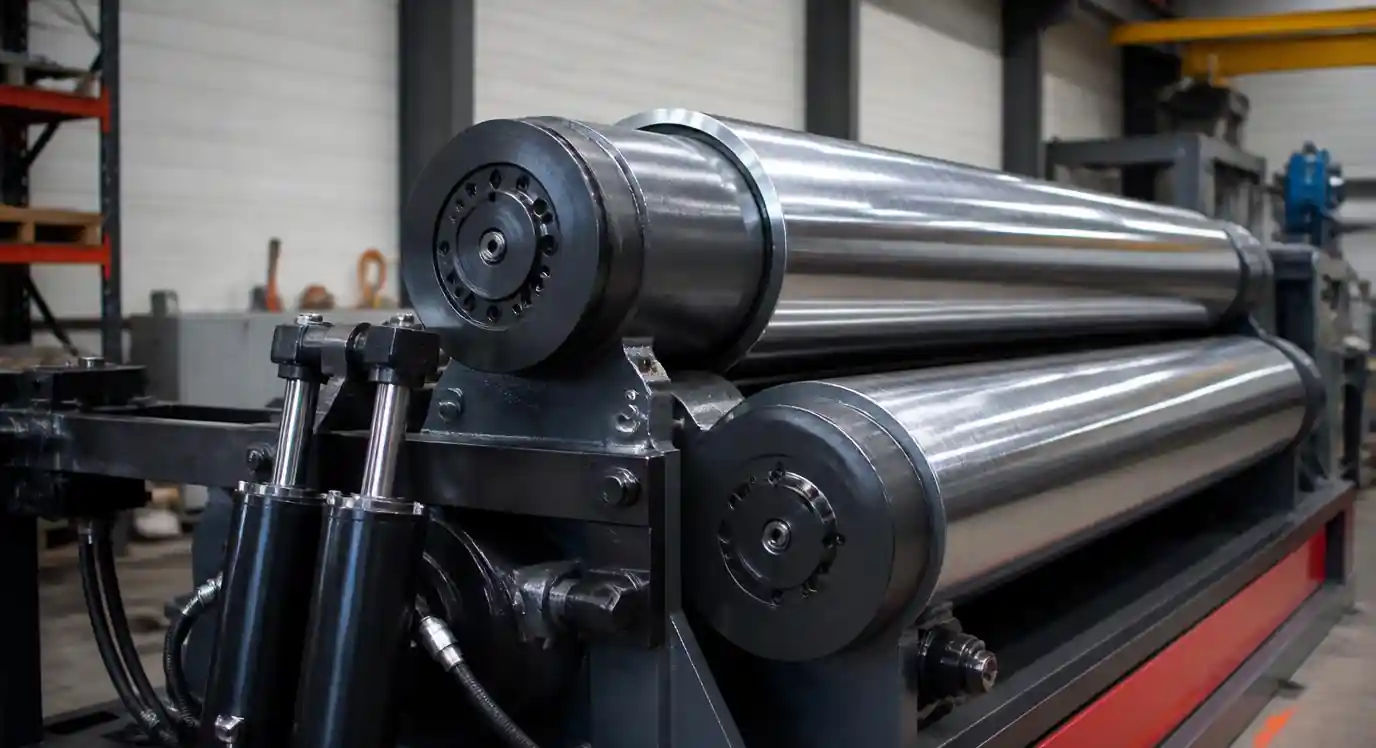 Crowned work roll design for pressure vessel plate rolling machine
We specify roll crowning based on FEA modeling: shells >4.5m length require parabolic crown, 0.8-1.2mm peak at roll center. EZHONG's wind tower plate rolling machines use adaptive crown control—hydraulic cylinders adjust roll camber in real-time based on measured plate deflection. This technology transferred from wind tower production now appears in pressure vessel equipment.
Three-roll machines require auxiliary pre-bending: hydraulic press with radius die (accurate but slow, 8-12 min per edge), dedicated edge roller (fast at 3-4 min but requires precise alignment), or initial passes with reduced roll gap (material-dependent, risks surface marking). Four-roll machines eliminate this entirely.
Plate rolling machines fall under OSHA 1910.212 (US) and EN 693 (EU). Critical requirements include roll nip point guards, emergency stops within 600mm reach, light curtains for operator-side access exceeding 1 meter, and pressure-holding devices during roll changes. EZHONG's CE-marked machines include interlock systems preventing roll rotation when guard panels are open.
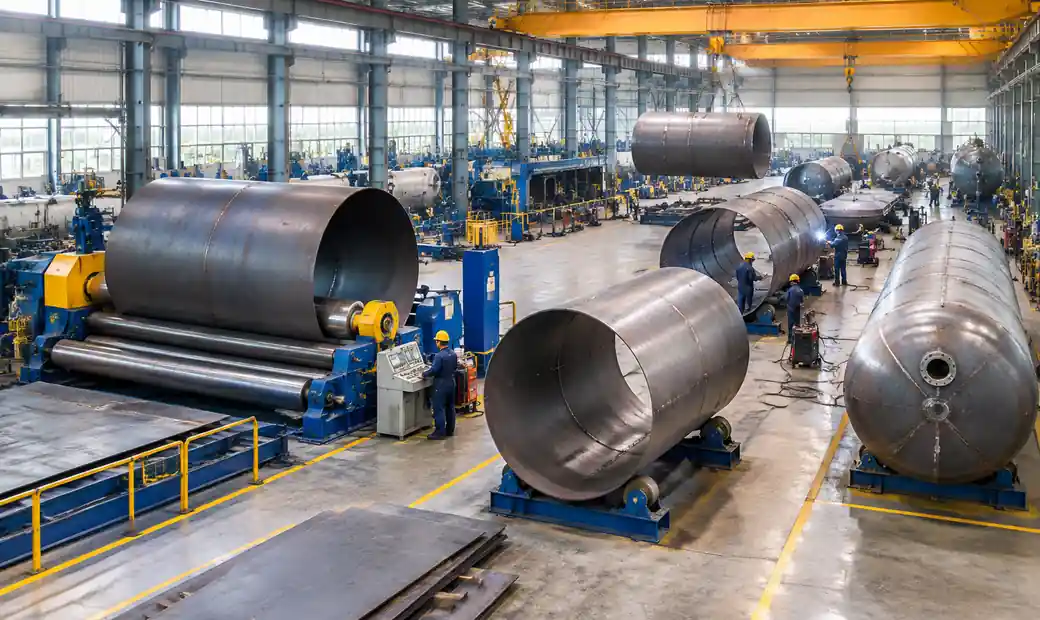 Pressure vessel fabrication shop with plate rolling and forming equipment
Automated diameter measurement: Laser-based systems measure formed diameter in real-time, cutting 4-6 minutes per shell and catching out-of-tolerance conditions before plate exits the machine.
Quick-change roll systems: Hydraulic roll extraction reduces changeover from 4-6 hours to 45-60 minutes. For shops running mixed shell diameters daily, this adds 8-10 production hours weekly.
Integrated plate handling: Powered infeed tables eliminate crane dependency. On shells requiring 8-12 passes, this saves 15-20 minutes per piece.
EZHONG customers running pressure vessel production solutions report 35-40% cycle time reduction after implementing these upgrades versus baseline manual operations.
What plate thickness requires specialized pressure vessel rolling equipment?
General-purpose machines handle up to 40mm in vessel alloys reliably. Beyond 50mm, you need purpose-built equipment with oversized hydraulic systems, larger diameter rolls (400mm+), and reinforced frames. At 75mm+, pre-heating capability becomes essential regardless of material grade. See ASME Section VIII fabrication requirements.
How does PWHT affect vessel dimensions?
Post-weld heat treatment at 595-650°C causes thermal expansion and stress relief. Expect 2-4mm diameter growth on carbon steel vessels, 3-6mm on chrome-moly alloys. Form shells 0.3-0.5% undersized to compensate. The exact value depends on shell diameter, thickness, and heat treat time at temperature.
Can three-roll machines meet ASME tolerances?
Yes, with proper pre-bending of plate edges and operator skill. However, four-roll machines achieve compliant shells faster with less operator dependency. For shops producing fewer than 10 vessels monthly, three-roll equipment with press pre-bending remains cost-effective.
What roll surface finish is required?
Work rolls should maintain Ra 0.8-1.6 µm surface finish. Rougher surfaces embed contamination; smoother finishes don't add value. We re-grind rolls every 600-800 production hours for carbon steel work, 400-500 hours for abrasive materials like SA-537.
How do you prevent hydrogen cracking during cold forming of high-strength vessel plate?
Three controls: pre-heat plate to 150-200°C for yield strengths above 550 MPa, store plate indoors at <50% relative humidity before forming, and limit time between forming and stress relief to <48 hours. If these aren't feasible, specify lower-strength alternatives.
What's the typical lead time for specialized pressure vessel equipment?
Standard four-roll machines in common capacities (40×3000mm, 50×3000mm): 16-22 weeks. Custom machines with specialized configurations or extreme capacities (80×4000mm+): 28-36 weeks. Lead time includes engineering approval drawings, your review, and build time.
Pressure vessel manufacturing demands forming equipment engineered for extremes of thickness, material strength, and dimensional precision that general plate work never encounters. The gap between adequate and purpose-built shows up in pre-bend requirements, setup times, and scrap rate on $12,000 chrome-moly shell courses.
Four-roll CNC servo machines deliver the fastest path to ASME-compliant shells when production volume justifies capital investment. Three-roll configurations remain viable for lower-volume shops willing to invest in operator training and auxiliary equipment. Either way, the hydraulic system, roll sizing, and quality integration separate production assets from expensive ornaments.
EZHONG's pressure vessel rolling solutions incorporate 60+ years of heavy plate forming experience, with specific engineering for ASME Section VIII applications. Our machines operate in AI-certified shops across refining, power generation, and chemical processing industries where vessel quality isn't negotiable.